
Are Cash Home Buyers Legitimate?
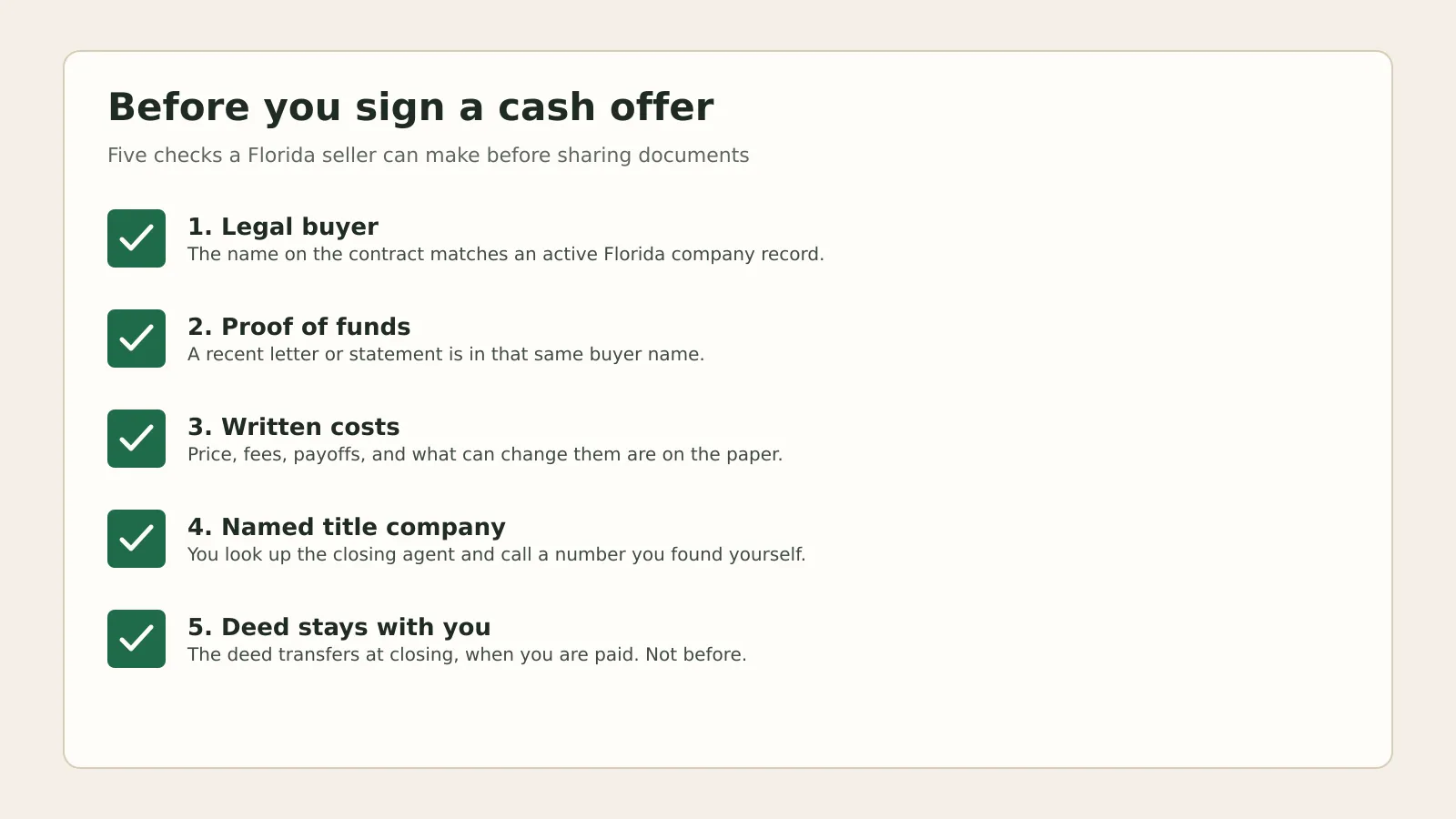
Are cash home buyers legitimate? Some are. Some are not. A real cash buyer purchases the house with their own money or a company they control, puts the terms in writing, and closes through a title company. A bad actor asks for money up front, pushes you to sign a deed before you are paid, or will not show where the funds come from. Do not pay a company before it delivers what it promised. A deed you sign over before you are paid is hard to undo.
This checklist is for Florida homeowners who want to check a buyer before sharing documents or signing anything. It covers identity, license rules, written terms, costs, timing, and the warning signs that should make you pause. It is not legal, tax, or financial advice. Your contract and your title situation decide what is safe. Ask a Florida real estate attorney or a HUD-approved housing counselor before you sign if anything is unclear.
Explore a cash offer when you want a written Florida offer you can check against this list. You can also call (786) 833-7970. A request is not a contract.
Are cash home buyers legitimate in practice
A legitimate cash home buyer purchases the house as the owner. They are not your listing agent. They can explain who will hold title, where the purchase money will come from, and which title company will handle closing. They give you time to read the contract. They do not charge a fee just to look at the house or to send an offer.
Legitimacy is not the same as the highest price. A direct buyer often pays less than a retail listing price because they take on repairs, holding time, and resale risk. That gap is a tradeoff, not proof of a scam. What matters is whether the written offer matches the marketing. You should also be able to verify the buyer and keep the deed until you are paid.
Public ads are not transaction terms. "We buy houses" on a website does not lock in a price or a closing date. It also does not promise that every fee is covered. Those points belong in the purchase contract you read before you sign. If an inquiry form says the request is not a contract, treat it that way.
Check the company before you share documents
Start with the name on the offer, not the name in the ad. Ask for the legal entity that will sign the contract and take title. Then look that name up yourself.
- Search the legal name on the Florida Division of Corporations Sunbiz site and confirm the company is active, not dissolved.
- Match the people named on Sunbiz with the people who called you. A mismatch is a reason to ask more questions, not a reason to ignore it.
- Read recent reviews, and also search the company name plus "complaint." One angry review is not a verdict. A pattern of changed offers, missing closings, or pressure is.
- Ask which Florida markets they actually buy in. A company that cannot describe how it buys locally is harder to verify.
- Get a direct phone number and a street or mailing address you can check. A form with no named person is not enough.
Total Cash Home Buyers is a Florida direct buyer that has operated since 2018. The company buys unlisted residential houses from owners. On the Florida Division of Corporations record checked on November 20, 2026, TOTAL CASH HOME BUYERS, LLC is active, and Brandy Pollack is listed as manager and registered agent. Use that filing, not a marketing title, when you match the person who contacts you. You can read the company's own description on the about page, then compare both sources with whoever contacts you. A match is a starting point. It is not a substitute for reading the contract.
Do not send your mortgage statement, ID, or deed until you know who is asking and why. A buyer who needs property details to price a house can start with the address, condition, and what you already know. Sensitive documents can wait until you are comfortable with the written offer.
Does a cash buyer need a Florida real estate license
Often, no. Florida Statute 475.011 says the licensing law does not apply to an individual or company that sells, exchanges, or leases its own real property. The exemption has limits. Buying a house in your own name, or in a company you own, to hold or resell later is generally a principal transaction. You can read the exemption on the Florida Senate statute page.
A missing license is not, by itself, proof of a scam. The Florida Department of Business and Professional Regulation licenses brokers and sales associates who represent other people for pay. A direct buyer who purchases for their own account is in a different role. You can still look up a claimed license on the DBPR license search if someone says they are a broker.
The line moves when someone markets another owner's house, assigns contracts for a fee, or gets paid to bring a buyer and a seller together. That activity can require a Florida real estate license. If a "buyer" will not say whether they plan to close and take title, ask before you sign. Ask the same thing if they plan to assign the contract to someone else. Wholesaling sits in a gray area. This article is not a legal opinion on any one deal.
Ask one plain question: "Will your company be the buyer on the deed at closing?" A yes, with proof of funds and a named title company, fits a direct purchase. A vague answer is a reason to slow down.
Compare marketing claims with the written terms
Legitimate buyers can explain the offer in writing. The paper should name the buyer, the price, and what is included. It should also say who pays which costs, how the closing date is set, and any right to inspect or cancel. If a spoken promise is not in the contract, assume it is not part of the deal.
| Question to ask | What a clear answer looks like | Pause if you hear this |
|---|---|---|
| Who is the buyer? | A legal name you can find on Sunbiz, matching the contract | "My investor" or a name that keeps changing |
| Is the price fixed in writing? | A dollar amount, plus any conditions that can change it | "About this much" with no contract |
| Who pays closing costs? | A line that says which party pays title, transfer, and related fees | "No costs" with blank fee lines |
| When do you close? | A date, or a process tied to title and your schedule | A guaranteed day with no title review |
| Can the buyer cancel? | Named contingencies, such as title or inspection, with a deadline | Open-ended rights and no deadline |
| When does the deed transfer? | At closing, when you are paid and loans are handled | Sign the deed now, get paid later |
Read every contingency. A cash offer can still depend on a clear title, an inspection, or a partner's approval. Those conditions are not automatically unfair. Hidden ones are. If the buyer can walk away for any reason, for as long as they want, you do not have a firm deal.
Also separate an advertised fast close from the calendar in the contract. Some direct sales close in a short window when title is clear and both sides are ready. Others take longer because of liens, probate, or a lender payoff. "A few days" on a website is not a promise. It does not mean your house will close on that schedule. The FTC also flags pressure to sign before you have read the papers. Take the contract home. A buyer who will not allow that is telling you something.
Confirm funds, fees, and who handles closing
Ask for proof of funds that matches the purchase price. Also ask which account or company will bring the money to closing. A recent bank letter or account statement in the buyer's name is the usual evidence. A screenshot with no name, or a promise that "funding is lined up," is weaker. You need to see that the money exists and that it belongs to the party on the contract.
Closing should run through a title company or closing attorney you can look up. It should not run through a personal payment app, a wire to an unknown account, or a parking-lot meeting. Ask for the company name, then find its phone number yourself and call to confirm they have your file. The Consumer Financial Protection Bureau warns that scammers copy closing emails and send fake wiring instructions. Confirm any wire by phone with a number you already trust. Do not use the number printed in the email that asked you to wire.
Upfront fees are a hard stop for most homeowners. A company that is buying your house should not need an application fee or a processing fee before it makes an offer. It also should not ask you for earnest money. A practical rule is not to pay until the company delivers what it promised. Paying your own attorney or a title search you ordered yourself is different. Paying the buyer, or a stranger who says they will stop a foreclosure, is not.
Costs can still exist even in a "no seller fees" sale. Those can include a mortgage payoff, property taxes, liens, prorations, and other amounts the title company must clear. Those are obligations tied to the property, not a commission. Ask for a draft settlement statement before closing day so you can see the cash you will actually receive. For a closer look at who pays which lines, read who pays closing costs when selling a house in Florida.
Warning signs that should make you stop
Pause and get advice if you see any of these signs.
- They want money before you have a written offer or a closing date.
- They ask you to sign the deed now and promise payment later.
- They tell you to send mortgage payments to them instead of your servicer.
- They guarantee they can stop a foreclosure. An offer does not do that. Call your servicer, and use a HUD-approved counselor if you are behind.
- They refuse to name the title company or will not show proof of funds.
- The price, the buyer name, or the fees change after you thought you had a deal, with no clear reason in the contract.
- They discourage you from letting a lawyer or a family member read the papers.
Skip rescue offers that demand payment first or ask for the deed before you are paid. If you suspect a scam, you can report it at ReportFraud.ftc.gov. If you already wired money, call your bank immediately and ask about a recall.
None of this means every direct buyer is a risk. You should be able to verify the boring parts: the company, the money, the paper, and the closing agent. A buyer who is legitimate will not be offended by those questions.
How a careful Florida cash sale usually moves
A normal direct sale has a few visible stages. You share the address and the situation. The buyer reviews the house, nearby sales, and likely repairs, then sends a written offer if the property fits. You read it, ask questions, and either accept, decline, or keep looking. If you accept, a title company checks ownership, liens, and payoffs. You sign at closing and receive the funds the statement shows. An inquiry is not an acceptance. A signed contract is.
On a direct sale with Total Cash Home Buyers, the public process is the same shape. You can see how the as-is purchase works. You share the house, get an individualized review, and receive an offer if one is appropriate. You close at a title company only if you accept. The company states that an as-is purchase does not require cleanup, repairs, staging, or ordinary listing showings. It also states there are no company-stated seller commissions or closing costs. Offers are property-specific. They can reflect the home's history, nearby comparable sales, and anticipated repairs. Closing timing, if you accept, is discussed from the property and the transaction. It is not a date the website can promise you today.
Use that description as a benchmark, not as a reason to skip the checklist. Ask the same identity, funds, fee, and contingency questions you would ask any other buyer. If you want the longer review that starts after an offer arrives, the cash offer due diligence checklist covers title, repairs, and co-owners. If you are still deciding between a direct sale and a listing, read the comparison of cash buyers and agents. That is a separate question from whether a buyer is legitimate.
Questions worth asking before you sign
Bring this short list to the first real conversation. Write down the answers, then check them against the contract.
- What is the legal name of the buyer, and will that name be on the deed?
- Can I see proof of funds in that name before I sign?
- Which title company will close, and may I call them myself?
- What costs come out of my proceeds, including liens, taxes, and payoffs?
- What can change the price after today, and what is the deadline for that change?
- What is the closing date, and what happens if title is not clear by then?
- Do I keep the deed until I am paid at the closing table?
- May I have a lawyer or a family member review this before I sign?
You should be able to get plain answers. If the person changes the subject, rushes you, or tells you the questions are unusual, treat that as information. You can also read seller reviews on the testimonials page as one more public source, then still verify the contract in front of you. Reviews do not replace a settlement statement.
If the numbers and the process still make sense after that review, the next step is a documented conversation, not a signature on the spot. You can explore a cash offer and compare that written offer with any other option you are considering.
If the checklist checks out and you want a documented next step, explore a cash offer or call (786) 833-7970. You can decline after you read the offer.
Frequently asked questions
Are cash home buyers legitimate if they are not real estate agents?
They can be. In Florida, a person or company can buy property for its own account without a real estate license under the owner exemption in Statute 475.011. You still need a written contract, proof of funds, and a title company. A license matters when someone represents you, or other owners, for pay.
Should I pay a fee to get a cash offer?
No. A buyer should not charge you to evaluate the house or to send an offer. Do not pay a company before it delivers what it promised. You can still choose to hire your own attorney. That fee goes to your attorney, not to the buyer.
Does a cash offer mean I get paid immediately?
No. You are paid at closing, after the title work and any payoffs the contract requires. Some sales move quickly when title is clear. Others take longer. Marketing that mentions a short timeline is not a guarantee for your property.
Can a cash buyer stop my foreclosure?
Do not count on it. A purchase might change your timeline only if it actually closes and the lender is paid. Even then, the result depends on your loan and the sale date. Call your mortgage servicer. If you want counseling, use a HUD-approved housing counselor. Ignore anyone who asks for the deed or a fee in exchange for stopping the foreclosure.
What is the single best check before I sign?
Match three things: the legal buyer on the contract, proof of funds in that name, and a title company you called yourself. If any one of those is missing, do not sign yet.
Get a written offer you can verify
If you want a Florida buyer you can question in writing, start with a no-obligation request. Total Cash Home Buyers reviews the property on its own facts. When an offer is appropriate, the company puts it in writing for you to accept or decline. A form submission is not a contract. Call (786) 833-7970 or explore a cash offer when you are ready to compare a documented offer with your other choices.
Discuss your property and your next step
Bring your questions and the information you have gathered. Review any written offer and its terms before making a decision.